
LCWM Licensed · Riverview, FL · 33578 & 33569 · Hillsborough County
Rodent Control Riverview, FL
We Find Every Entry Point. Seal It. End It.
When Hurricane Milton pushed the Alafia River out of its banks in October 2024, thousands of rats were displaced from Bell Creek, the retention pond corridors, and the mango and avocado groves throughout Riverview. Those rats moved uphill into Panther Trace, FishHawk Ranch, Waterset, Lake St. Charles, South Fork, and Summerfield. Most pest companies set bait stations. The rats come back in 72 hours. Professional rodent control in Riverview, FL means closing every entry point permanently — and we never leave until the problem is solved.
Monday–Saturday 7AM–7PM · Same-Day Appointments Available · No Monthly Contracts
What Makes Rodent Shield Riverview Different From Every Other Pest Company
We built everything around one problem. Not ants. Not termites. Not mosquitoes. Rats.
🐀
Rodent-Only Focus
100% of our training, equipment, and protocols built for roof rats and mice — not ants, termites, and mosquitoes.
🚫
No Poison — Ever
Dead rats in Riverview’s heat smell within 48 hours and persist 2–3 weeks. Mechanical traps only. Safe for families and pets.
📋
LCWM-Certified
Florida law requires LCWM certification from the Dept of Agriculture for mechanical trapping. Most pest companies can’t show you theirs. Ours can.
💰
Transparent Pricing
Price ranges published upfront. No “call for a quote.” Inspection fee credited toward any approved work.
🛡️
90-Day Protection
If rodents re-enter through any sealed point within 90 days, we come back at no charge. No fine print, no exceptions.
🌊 Why Riverview Has More Rats Than Anywhere Else in Hillsborough County
After 19 years working in rodent exclusion across Tampa Bay, I can tell you without hesitation that Riverview has the most complex rodent pressure of any suburban market in the region. The geography is the reason. The Alafia River runs along the northeastern border of the city, creating a natural flood corridor that connects to the bay. Bell Creek Nature Preserve at 10940 McMullen Rd in 33569 is 200 acres of undisturbed habitat sitting inside a ring of master-planned subdivisions. And every community from Panther Trace to FishHawk Ranch to Waterset was built around retention ponds designed to manage Florida’s 54 inches of annual rainfall.
Those retention ponds are not a landscape feature. They are rodent highways. Roof rats travel along water edges, using the pond banks as movement corridors between neighborhoods. A single female rat can produce 40 offspring per year. The populations living in the preserve and along the Alafia flood plain feed outward into the subdivisions when food sources dry up. When the avocado crop drops in August through October and mangoes finish in July, those animals start looking for something else to eat. Your attic is warm, dry, and full of nesting material.
Why do neighborhoods like Panther Trace and Summerfield have higher rodent pressure than inland Riverview communities?
Because they are adjacent to Bell Creek and the Alafia river basin. The natural buffer between the preserve and the subdivisions is measured in hundreds of feet, not miles. Palm canopies in those neighborhoods typically touch across the property lines, creating an aerial highway that roof rats use to travel from tree to tree without touching the ground. A mature mango or avocado tree overhanging your roofline is not just a nice amenity — it is a direct on-ramp to your attic.
Hurricane Milton changed the calculus further. In October 2024, Milton dropped 16 inches of rain on Hillsborough County in under 24 hours. The Alafia River reached historic flood levels. Rescue teams conducted over 225 water rescues near Lithia Pinecrest Road alone. The rodent populations living in the flood plain were displaced by the millions. They went where dry ground was: uphill, into the subdivisions, into the attics of homes that had never had a rat problem before.
❓ What’s the difference between roof rats, palm rats, citrus rats, and Norway rats?
Roof rat, palm rat, fruit rat, citrus rat, and black rat are five names for the exact same animal: Rattus rattus. In Riverview and throughout Tampa Bay, this is the primary species — they climb, live in upper structures, and are active after dark. Norway rats (Rattus norvegicus) are larger, heavier, and prefer ground-level locations near water. Riverview has elevated Norway rat pressure along the Alafia River corridor and in post-hurricane displacement events. We identify both during inspection and adjust the exclusion strategy accordingly.
📅 The Seasonal Pattern Every Riverview Homeowner Should Know
| Month / Season | Riverview-Specific Pressure Driver | Activity Level |
|---|---|---|
| Jun–Aug (Rainy Season) | Flooding pushes ground-level rodents up into attic spaces; mango fruit drop begins July | HIGH |
| Sep (Transition) | Mango ends, avocado begins; rodents shift food sources toward structures | HIGH |
| Oct–Nov (Peak) | Avocado drop, hurricane season overlap, post-storm displacement; Milton 2024 anniversary pressure | PEAK |
| Nov–Jan (Citrus) | Citrus season; cool nights drive rats to warm attic spaces | PEAK |
| Feb–May (Lower) | Fewer food drivers, but established colonies continue activity; breeding season | MODERATE |
🚨 Signs You Have Roof Rats in Your Riverview Home Right Now
Roof rats in 33578 and 33569 follow the same playbook. If you recognize two or more of these, you have an active colony — not a single animal passing through.
🔊
Scratching After 9 PM
Roof rats are nocturnal. Scratching, scurrying, or thumping sounds in the ceiling or walls after dark — especially between 9 PM and 3 AM — is the most reliable first signal of an active infestation.
💩
Banana-Shaped Droppings
Roof rat droppings are 0.5–0.75 inches long with pointed ends and a curved shape. Mouse droppings are smaller (0.25 inches) with blunt ends. If you see them in the attic, along rafters, or near the water heater, the colony is already established.
⚡
Gnaw Marks on Wiring
Rats gnaw constantly to wear down incisor teeth that never stop growing. Chewed wiring insulation in the attic is a fire hazard and a direct sign of active roof rat presence. The NFPA estimates rodent-chewed wiring is a contributing factor in roughly 25% of house fires with undetermined causes. This is not a minor issue — it is an insurance claim waiting to happen. (NFPA)
🛤️
Grease Smudge Trails
Roof rats travel the same routes repeatedly. Body oils from their fur leave dark smudge marks along rafters, joists, and the wall edges of attic spaces. If you see dark streaks along beams, you are looking at an established travel route — a colony has been there long enough to wear in a path.
🍊
Damaged Fruit on Your Trees
Partially consumed mangoes, avocados, or citrus still on the tree — with hollowed-out centers and tooth marks on the rind — mean roof rats are already using your trees as a food source. The next step is your roofline. A tree branch within four feet of the fascia is a runway.
💨
Ammonia Smell in Attic
A strong urine or ammonia odor coming from the attic space or upper walls indicates a large, established colony. The smell comes from accumulated urine in insulation. At this stage, the infestation has been active for months and attic remediation will likely be necessary after exclusion.
Recognizing 2 or more of these signs? Call (813) 591-5726 — same-day inspections available.
💸 What Most Riverview Homeowners Try First (And Why It Keeps Failing)
A homeowner in Riverview will hear scratching in their ceiling at 2 AM. They will call a major pest company — Anti-Pesto, Massey, or one of the national chains. A technician arrives, places bait stations in the attic, and books a monthly service plan at $35 to $50 per month. The homeowner feels like the problem is being handled. Within three to four days, the scratching is quieter. A week later, it starts again. The technician comes back. More bait. Another month of charges. Three months in, the family is $150 deeper and the rats are still in the attic.
We have personally spoken with homeowners in Panther Trace who tried three separate pest companies over six months and still had active rats when they called us. One family in the FishHawk area spent over $1,500 with two different companies — both of which set bait stations without ever locating or sealing a single entry point. One company told them to “give it time.” A family on Lake St. Charles was quoted $1,800 for a service upgrade before the technician had even been on the roof.
If bait stations work, why do rats keep coming back after treatment?
Because bait kills the rats currently inside your home, but does nothing to prevent the next wave. Rats leave pheromone scent trails — chemical markers in their urine and gland secretions — that act as a GPS signal for every rat in the surrounding population. Within 48 to 72 hours of the existing colony dying, new animals follow those trails directly to the same entry points and re-establish. The entry points are still open. The pheromone trails are still active. Nothing has changed except you are out another month of service fees.
Anti-Pesto operates a Riverview office at 6619 S 78th Street, Suite 116, in 33578. Their standard rodent program is $41 per month. It includes bait stations. It does not include sealing entry points. Massey Services has active Riverview accounts that have been paying monthly for over a year with documented recurring infestations. These are not bad companies — they are general pest companies doing general pest work. Rodent exclusion is a specialty. Our entire operation is built around one species and one outcome: permanent exclusion.
What to Demand From Any Rodent Control Company Before Signing Anything
- Ask them to identify and show you every active entry point on the structure before any treatment begins
- Ask what material they use to seal entry points — caulk and foam are not permanent; 19-gauge stainless steel hardware cloth is
- Ask if they seal before trapping, or trap before sealing — if the answer is trap first, walk away
- Ask for LCWM certification proof — Florida law requires it for mechanical trapping; if they cannot show it, they are operating illegally
- Ask what happens if the problem returns — if the answer is “another service visit” at additional cost, they are not solving the root problem
⚙️ How Rodent Control Riverview FL Actually Works — 6 Steps to Permanently Solving It
Every step in sequence. No shortcuts. No bait-station subscription to replace a process that works.
01
📞 Call & Quick Phone Assessment
We take 10 minutes to understand what you are hearing, where, and when. This tells us whether you are dealing with a roof rat colony, Norway rat ground activity, or something else entirely. We ask about your neighborhood, fruit trees, and proximity to water. This is not a sales call — it is triage. We schedule same-day or next-day depending on urgency.
02
🏠 Full Roof & Attic Inspection
We start on the roof. Every ridge vent, soffit gap, gable vent, AC conduit penetration, fascia board joint, pipe chase, and utility entry is inspected. In Riverview’s concrete block and stucco construction, we pay particular attention to where the roof deck meets the wall plate — a common gap that appears closed but is not. We then enter the attic to assess active activity, nesting, contamination, and chew damage to wiring and insulation.
03
📋 Map & Document Every Entry Point
Every active entry point is photographed with GPS coordinates and documented in a written report you keep. We identify the material failure type (UV-degraded end cap, wood gap, failed foam sealant, stucco crack) and specify the fix before a single trap is set. You see exactly what we found, exactly where, and exactly what we plan to do. No surprises on the invoice.
04
🛡️ Seal Every Entry Point First
We seal before we trap. Always. We use 19-gauge stainless steel hardware cloth as the primary material — not galvanized steel, which rusts in Riverview’s coastal humidity within 18 months. Smaller penetrations get copper mesh and closed-cell foam. Fascia and soffit gaps get flashing and UV-rated sealant. We do not use foam alone — rats chew through it in hours. Every closure is rated to outlast the structure. Once sealed, no new animals can enter.
05
🗑️ Interior Clearance & Carcass Removal
With entry points sealed, we clear the existing population using mechanical trap placements in the attic and wall void access points. We return to remove every carcass — leaving a dead rat in your attic creates a secondary blow fly infestation and a smell that takes months to clear. We also inspect attic insulation for contamination and provide a written assessment with photos. No poison. No secondary kill risk to pets or raptors.
06
✅ Final Confirmation + Written Documentation
We conduct a post-clearance inspection to verify the structure is clean, every sealed point is holding, and no new activity has developed. You receive a written close-out report with photos of every sealed entry point. This report satisfies HOA documentation requirements and serves as proof of remediation for insurance purposes. If anything is still active, we come back — no extra charge.
❓ What is LCWM certification and why does it matter when hiring rodent control in Riverview, FL?
LCWM stands for Limited Commercial Wildlife Management. Florida law — enforced by the Florida Department of Agriculture and Consumer Services (FDACS) — requires this certification for anyone performing mechanical trapping and removal of rodents on a commercial basis. A technician without LCWM certification performing paid trapping work in your home is operating illegally in Florida. Before you authorize any company to set traps on your property, ask to see their LCWM certificate number. We carry it. We will show it on request.
Average Riverview job: 1–2 service visits. No monthly contracts. Written documentation of every entry point found and sealed.
📍 3 Real Riverview Jobs — What We Actually Found
Specific neighborhoods. Specific entry points. Specific outcomes.
Case Study — Panther Trace, 33579
Mango Tree Bridge to Ridge Vent: 4 Active Entry Points
Homeowner heard what she described as “someone sprinting across the ceiling after dark” for three weeks before calling. Two previous service calls from a national pest company had placed bait stations in the attic. Active scratching continued. When we arrived, we found a mature mango tree with branches overhanging the roofline by approximately four feet. The canopy provided a direct bridge at the height of the ridge vent. We found four active entry points: a damaged end cap on the ridge vent, two soffit gaps where the fascia board had pulled away, and a utility penetration at the AC conduit sealed with foam — which had been chewed through. We sealed all four with 19-gauge stainless steel hardware cloth and flashing. Interior trap placement cleared five animals over two visits. No recurrence confirmed at 9-month follow-up.
Result: Problem solved in 2 visits. No monthly service. $0 in ongoing fees.
Case Study — South Fork / Waterset border, 33572
Post-Milton Norway Rat Displacement: First-Time Infestation After 11 Years
This family had lived in their home for 11 years without any rodent issue. Six weeks after Hurricane Milton, they called us. They had already tried two pest companies. Both had set bait stations. The scratching persisted. When we inspected, we found Norway rat activity distinguishable from roof rat activity by the burrow patterns and the size of the droppings. Norway rats displaced from the Alafia River floodplain had moved south and uphill as the basin dried. Entry was through a gap in the garage foundation where the stucco had cracked and separated from the slab at the corner, plus a plumbing penetration in the garage wall used for the washer drain. Both sealed. Confirmed clear.
Result: First actual solution after 2 failed attempts by other companies.
Case Study — Lake St. Charles, 33578
Lake Perimeter + Citrus Tree: HOA Complaint Resolved in 1 Visit
Homeowner on the perimeter of Lake St. Charles received an HOA notice about a visible burrow system near the lake bank on their property. Simultaneously, they had been hearing activity in the soffit area above the garage for approximately two months. On inspection: roof rats using a citrus tree adjacent to the roofline as a bridge, with entry via a 1.25-inch soffit gap where the fascia board met the corner trim. The attic had contaminated insulation in the northeast quadrant. We sealed the entry point, recommended trimming the citrus tree branches to six feet from the roofline, removed two pounds of contaminated insulation, and completed interior clearance in one combined visit. Homeowner forwarded the inspection report to the HOA. No follow-up complaint issued.
Result: HOA complaint resolved. Attic remediated. Problem eliminated in 1 visit.
Real Riverview Homes
Before & After — See the Difference
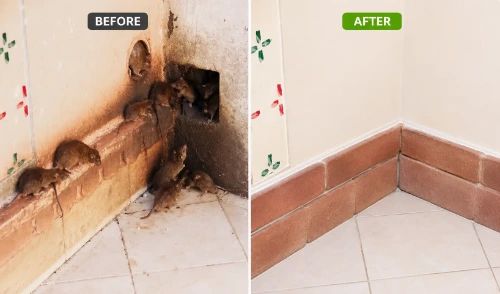
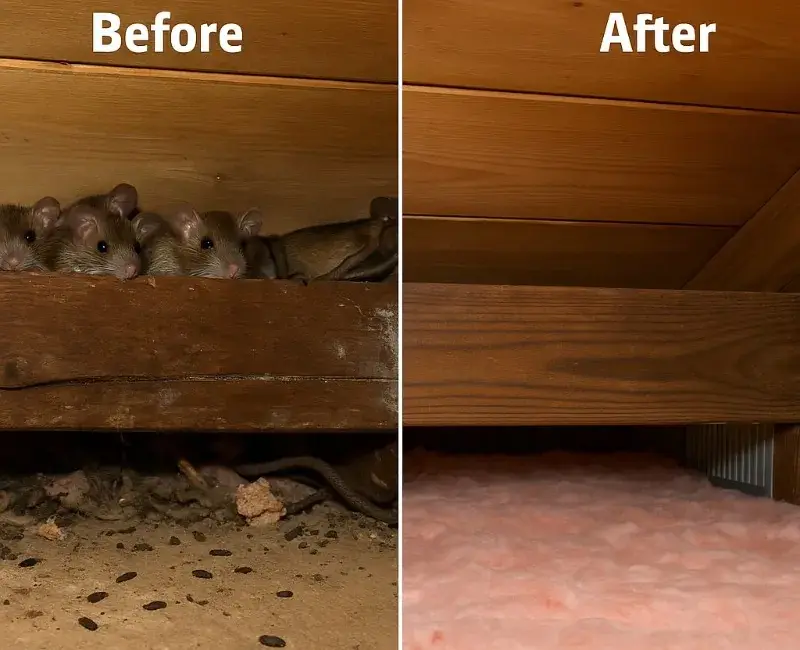
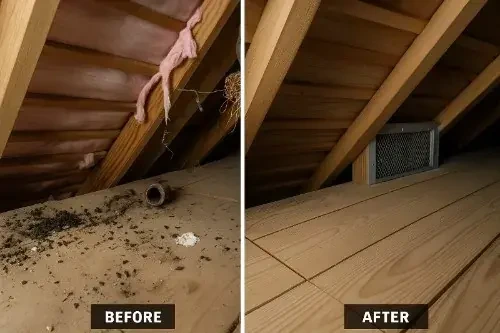
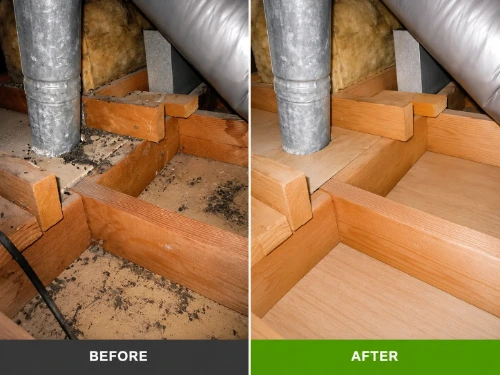
All photos from Riverview FL homes · GPS-documented · Written reports provided
🔧 Where We Find Entry Points on Every Riverview Rodent Control Inspection
Riverview’s housing stock is predominantly concrete block with stucco exterior, built between 1995 and 2020. These construction methods create predictable vulnerability patterns different from wood-frame homes. The following are the most common entry points we find, ranked by frequency.
| Entry Point | Frequency | Why It Happens Here | Our Permanent Fix |
|---|---|---|---|
| Ridge Vent Gaps | Very High | Florida UV degrades plastic end caps; palm tree access accelerates wear | 19-gauge stainless steel hardware cloth, sealed edges |
| Soffit-Fascia Gaps | Very High | Wood fascia expands and contracts in humidity cycles, creating progressive gaps | Aluminum flashing + sealant; mesh where gap exceeds 0.25 inches |
| Gable Vents | High | Plastic louvers crack or warp in heat; aluminum screens degrade | Full replacement with stainless steel mesh-backed vent covers |
| AC Conduit Penetrations | High | Foam sealant used at installation is chewed through; very common in Florida construction | Copper mesh + closed-cell foam + stainless collar where accessible |
| Stucco Cracks at Foundation | High after storms | Post-flood soil settlement creates separations at the slab line; Norway rats primary user | Hydraulic cement fill + surface sealant; excavation if active burrow present |
| Plumbing Penetrations | Moderate | Washer, dishwasher, and hose bibb penetrations frequently unsealed behind cabinets | Copper mesh pack + expanding foam; access panel installation if needed |
| Roof-to-Wall Plate Gap | Moderate | Florida construction code gap between roof deck and top plate; common in pre-2005 builds | Foam backer + sealant from attic side; mesh if gap exceeds 0.5 inches |
⭐ What Riverview Homeowners Say About Rodent Control That Actually Works
From homeowners across 33578, 33569, and 33579 who had already tried the monthly subscription route.
⭐⭐⭐⭐⭐
“I had two other companies come out over three months. Both set bait stations, charged me monthly, and the rats were still there. These guys came out, found four entry points on my roof I never knew about, sealed them all with stainless steel, and cleared the problem in two visits. It’s been eight months with no noise. Worth every penny — and they didn’t make me sign a monthly contract.”
Sandra M.
Panther Trace — 33579
⭐⭐⭐⭐⭐
“We lived here nine years without any rodent problem. Six weeks after Hurricane Milton, rats were in our attic. Two companies came out and both set bait. Didn’t help. Rodent Shield Riverview came out, explained exactly why the flooding had driven them in, found where they were getting in, sealed it, and handled everything in a week. Finally gone. Should have called them first.”
David R.
FishHawk Ranch — 33547
⭐⭐⭐⭐⭐
“We got an HOA violation notice about a burrow near our lake perimeter. Same time we’d been hearing scratching above the garage for two months. One inspection, one visit, problem solved. They gave us a photo report I forwarded straight to the HOA. No more complaints. The whole thing was done faster than I expected and the price was exactly what they quoted.”
Kim T.
Lake St. Charles — 33578
📍 Riverview Neighborhoods We Serve
We work throughout 33578 and 33569 and the surrounding Hillsborough County communities. If your neighborhood borders the Alafia River, Bell Creek Nature Preserve, a retention pond system, or any mature citrus or avocado grove, your rodent risk is elevated and we want to inspect before the problem becomes established.
- Panther Trace — High risk; Bell Creek adjacency and mango canopy density
- Summerfield — Bell Creek preserve border; older housing stock with more entry point wear
- Lake St. Charles — 70-acre lake perimeter; citrus and tropical fruit trees throughout
- FishHawk Ranch — Wooded corridors and retention pond systems; elevated roof rat activity
- South Fork — Alafia River flood zone; post-storm Norway rat displacement risk
- Waterset — Apollo Beach border; tidal influence on rodent population movement
- Boyette Park — Retention pond-adjacent lots throughout community
- Waterleaf — Newer construction; common AC conduit and fascia gaps in Florida-standard builds
- Hawks Fern — Adjacent to natural corridor; elevated palm canopy travel routes
- Riverview Crest / Four Winds — Mature landscaping creates access routes; older stucco entry point wear
Also serving: Gibsonton, Apollo Beach, Brandon, Valrico, Lithia, and Wimauma. Major corridors: US-301, CR-672 (Big Bend Rd), Bloomingdale Ave, Boyette Rd, Lithia Pinecrest Rd, and McMullen Rd.
❓ Do you work in HOA communities like Panther Trace and Lake St. Charles?
Yes, we work in HOA-managed communities throughout Riverview regularly. Our written inspection report with GPS-tagged photos is formatted to satisfy HOA documentation requirements when neighbors or boards are involved. If your HOA has specific access or signage requirements, let us know at booking and we will coordinate accordingly.
Get a Free Inspection for Your Neighborhood
Every inspection includes a full entry point audit with photos, a written report you keep, and a flat-rate quote. No upsell, no pressure, no monthly service pitch. If we cannot find a way in, you pay nothing.
Mention your neighborhood for priority scheduling during peak season
Signs You Have Roof Rats Right Now
- Scratching sounds in the ceiling after 9 PM
- Banana-shaped droppings 0.5–0.75 inches long with pointed ends
- Gnaw marks on wiring insulation in the attic
- Grease smudge trails along rafters from body oils
- Partially consumed fruit on trees with tooth marks on the rind
Rodent Shield Riverview vs. Every Other Option
This is exactly what differentiates a specialist from a general pest company.
| Rodent Shield Riverview | Anti-Pesto ($41/mo) | Massey / National Chain | General Pest Co. | |
|---|---|---|---|---|
| Rodent-only specialist | ✓ Yes | ✕ General pest | ✕ General pest | ✕ General pest |
| Seal entry points before trapping | ✓ Always | ✕ Bait only | ✕ Rarely | ✕ Rarely |
| 19-gauge stainless steel hardware cloth | ✓ Standard | ✕ Not used | ✕ Varies | ✕ Varies |
| LCWM Certified | ✓ Yes | – Unknown | – Varies | – Varies |
| Monthly contract required | ✓ No | ✕ Yes, $41/mo | ✕ Yes | ✕ Usually |
| GPS-documented inspection report | ✓ Yes | ✕ No | ✕ No | ✕ No |
| 90-day return guarantee | ✓ Yes | ✕ No | ✕ No | ✕ No |
❓ Frequently Asked Questions About Rodent Control in Riverview, FL
Will rats leave on their own if I stop leaving food out?
No. Once rats establish a colony inside a structure, they stay. The attic provides everything they need: warmth, shelter, nesting material, and protection from predators. They are not there because of your food — they are there because they found a way in. Removing food sources may reduce activity slightly but will not cause them to leave. The only way to resolve the problem is to find and seal the entry points that allowed them in.
Can a rat really squeeze through a hole the size of a quarter?
Yes. Rattus rattus can compress its body to fit through a gap as small as 0.5 inches in diameter. Their skull is the largest fixed structure in their body. If the skull fits, the rest of the body follows. That is why standard pest foam sealants fail — rats chew through them. Entry point closure requires rigid materials: stainless steel hardware cloth, copper mesh, or flashing-grade metal.
Why do I have rats if my house is clean?
Roof rats in Riverview are not inside your home because of cleanliness. They are there because of geography. If you live near Bell Creek, the Alafia River, a retention pond, or have mature fruit trees adjacent to your roofline, your property is attractive to roof rats regardless of how clean your home is. The tree canopy, the warmth of your attic, and the structural gaps that exist in virtually every Florida-built home are the actual attractants. This is a structural problem, not a hygiene problem.
How long does the full rodent control process take for a Riverview home?
Most Riverview homes are resolved in one to two service visits. The first visit covers the inspection and sealing of all identified entry points, plus interior trap placement. The follow-up visit (typically 5 to 7 days later) clears any remaining animals, removes trap infrastructure, and verifies the attic is clean. Homes with more complex structures or multiple entry points may require a third visit. We do not charge monthly fees — you pay for the work done, and once the problem is resolved, it is resolved.
How much does rodent exclusion cost in Riverview, FL?
The inspection is free. After inspection, we provide a flat written quote for the exclusion and clearance work. Most Riverview residential jobs fall in the $900 to $2,800 range depending on the size of the structure, the number of entry points, and whether attic remediation is required. We do not have a subscription model. The number in the quote is the number you pay. Compare that with a $41/month subscription that never ends — that is $492 per year, indefinitely, with no guarantee of resolution.
Stop Searching for Rodent Control Riverview — Call the Specialist Who Actually Solves It
Call us today for a free inspection. We will be on your roof within 24 to 48 hours, document every entry point with photos, and give you a flat written quote. No monthly contracts. No upsell. If we cannot find a way in, you pay nothing. We have resolved rodent control problems in Panther Trace, FishHawk Ranch, Lake St. Charles, South Fork, and Waterset for homeowners who had already tried everything else.
Insurance tip: Secondary rodent damage — including chewed wiring and contaminated insulation — may be covered under certain homeowners policies. Our written inspection report with photos serves as documentation for insurance claims. Ask your insurer what your policy covers before assuming you are out of pocket for remediation.
Serving Riverview FL — 33578 · 33569 · 33572 · 33579 · Hillsborough County · Monday–Saturday 7AM–7PM
LCWM Licensed · Panther Trace · FishHawk Ranch · Lake St. Charles · Summerfield · Waterset · South Fork · Boyette Park